Support our educational content for free when you purchase through links on our site. Learn more
Who Leads M83? Meet Anthony Gonzalez 🌌


Anthony Gonzalez is the founder, lead vocalist, primary songwriter, and creative force behind M83, the French electronic music project known for “Midnight City,” Hurry Up, We’re Dreaming, and its cinematic blend of synth-pop, shoegaze, dream pop, and ambient electronics.
So, who is the lead vocalist and founder of the French electronic music project M83? Anthony Gonzalez. He co-founded M83 with Nicolas Fromageau in Antibes, France, around 2001, then continued the project as its sole constant member after Fromageau’s departure.
Gonzalez does far more than sing. He plays synthesizers, keyboards, guitar, bass, piano, and percussion while shaping M83’s production into something that can sound like a bedroom confession one moment and a galaxy-sized film score the next. That contrast helped “Midnight City” reach No. 1 on Billboard’s Alternative Songs chart.
The fun twist? M83 is often called a band, but its studio identity is largely Gonzalez’s creation. Guest vocalists and touring musicians add important colors, yet Gonzalez remains the person steering the spaceship. 🚀
Key Takeaways
- Anthony Gonzalez founded M83 with Nicolas Fromageau in Antibes, France, around 2001.
- Gonzalez is M83’s lead vocalist and sole constant member, although guest singers appear throughout the catalog.
- He is also the project’s primary songwriter, producer, arranger, and multi-instrumentalist.
- M83 blends synth-pop, dream pop, shoegaze, ambient music, electronic rock, and cinematic composition.
- “Midnight City” became M83’s breakthrough hit and one of the defining electronic songs of the 2010s.
- Gonzalez co-composed the Oblivion film soundtrack with Joseph Trapanese.
- Nicolas Fromageau’s departure transformed M83 from a duo into Gonzalez-led studio project supported by collaborators and touring musicians.
- M83’s signature sound combines nostalgia, adolescent emotion, huge synthesizers, processed vocals, and science-fiction scale.
Table of Contents
- ⚡ Quick Tips and Facts: Who Leads M83?
- Anthony Gonzalez at a Glance
- The Short Answer: M83’s Lead Vocalist and Founder
- M83 vs. Anthony Gonzalez: Understanding the Project’s Identity
- 🌌 Who Is Anthony Gonzalez, the Founder of M83?
- Early Life, French Roots, and Musical Influences
- How Gonzalez Created the M83 Name
- The Meaning Behind M83’s Cinematic Sound
- 🎹 M83’s Formation and Early Electronic Music Years
- 2001–2005: First Recordings and the Debut Album
- The Creative Partnership Between Anthony Gonzalez and Nicolas Fromageau
- Why Nicolas Fromageau Left M83
- 📀 M83 Albums and Career Evolution
- 2005–2009: Before the Dawn Heals Us, Digital Shades Vol. 1, and Saturdays = Youth
- 2009–2015: Hurry Up, We’re Dreaming, “Midnight City,” and Global Success
- M83’s “Oblivion” Soundtrack and Film-Scoring Career
- 2016–2021: Junk, Volta, Tour Projects, and DSVII
- 2023–Present: Fantasy, Touring, and M83’s Latest Chapter
- 🎤 Who Sings on M83 Songs?
- Anthony Gonzalez’s Lead Vocals and Musical Role
- Key M83 Vocalists and Collaborators
- Susanne Sundfør, Mai Lan, Jonsi, and Other Featured Voices
- Why M83 Is More Than a Traditional Lead-Singer Band
- 🎧 Anthony Gonzalez’s Songwriting, Production, and Instruments
- Synthesizers, Drum Machines, Guitar, and Studio Production
- Shoegaze, Dream Pop, Synthpop, and Ambient Influences
- The Role of Nostalgia, Adolescence, and Science Fiction
- 🎬 M83’s Film, Television, and Popular Culture Impact
- “Midnight City” and M83’s Breakthrough in Mainstream Culture
- M83 in Film Trailers, Television, Advertising, and Video Games
- Anthony Gonzalez as a Film Composer
- 👥 M83 Members, Touring Musicians, and Collaborators
- Anthony Gonzalez’s Central Role in the Studio Project
- Notable Former Members and Live Performers
- How the M83 Live Show Expands the Studio Recordings
- 🏆 M83’s Critical Reception, Awards, and Recognition
- Hurry Up, We’re Dreaming and “Midnight City” Aclaim
- Oblivion Soundtrack Recognition
- Anthony Gonzalez’s Influence on Modern Electronic Music
- 🗓️ Anthony Gonzalez and M83 Timeline
- 2001: M83 Forms in Antibes, France
- 2005: M83 Becomes Anthony Gonzalez’s Solo Project
- 201: “Midnight City” Brings Worldwide Attention
- 2013: Gonzalez Scores Oblivion
- 2016–2023: Junk, DSVII, Fantasy, and Continued Touring
- ❓ Is Anthony Gonzalez Still the Lead Vocalist of M83?
- Does Anthony Gonzalez Sing on Every M83 Track?
- Is M83 a Band or a Solo Project?
- What Happened to Nicolas Fromageau?
- 🔍 Why Anthony Gonzalez Matters to M83’s Sound
- The Difference Between Founder, Frontman, and Lead Vocalist
- How Gonzalez Blends Human Emotion With Electronic Production
- The Lasting Legacy of M83’s French Electronic Pop
- Conclusion
- Recommended Links
- FAQ
- Who is the lead vocalist and founder of M83?
- Is Anthony Gonzalez the only member of M83?
- What is M83’s most famous song?
- What genre is M83?
- Did Anthony Gonzalez create the Oblivion soundtrack?
- Reference Links
Quick Tips and Facts: Who Leads M83? 🌌
If you want the full story behind the M83 project, here’s the answer before the synths start swelling: Anthony Gonzalez is M83’s founder, lead vocalist, primary songwriter, producer, and sole constant member. M83 began as a duo with Nicolas Fromageau in Antibes, France, around 2001, then evolved into Gonzalez’s long-running electronic music project.
| Fact | Answer |
|---|---|
| Founder | Anthony Gonzalez, with Nicolas Fromageau |
| Lead vocalist | Anthony Gonzalez |
| Birth date | March 13, 1980 |
| Origin | Antibes, France |
| M83 formed | Around 2001 |
| Project name | Inspired by the Messier 83 galaxy |
| Best-known song | “Midnight City” |
| Signature styles | Synth-pop, dream pop, shoegaze, ambient, electronic rock |
| Sole constant member | Anthony Gonzalez |
| Breakthrough album | Hurry Up, We’re Dreaming |
| Major film score | Oblivion, co-composed with Joseph Trapanese |
Anthony Gonzalez at a Glance 🎹
Gonzalez is not merely the person standing near the microphone while a mysterious bank of synthesizers glows behind him. He has written, arranged, programmed, performed, mixed, and produced much of M83’s recorded catalog. His credited instruments have included:
- Synthesizers and keyboards
- Guitar and bass
- Piano
- Drums and percussion
- Programming and electronic production
- Lead and supporting vocals
- Arrangement, mixing, and production
That broad role explains why M83 can sound like a band, film orchestra, shoegaze wall, and teenage bedroom memory within the same song. The AllMusic overview of M83 also identifies Gonzalez as the project’s central creative figure.
The Short Answer: M83’s Lead Vocalist and Founder 🎤
Anthony Gonzalez is the lead vocalist and founder of M83.
He co-founded the project with Nicolas Fromageau, but Fromageau later departed after touring around the Dead Cities, Red Seas & Lost Ghosts era. Gonzalez then continued M83 as a primarily solo studio project supported by guest performers and touring musicians.
The wording can get slippery because M83 is often presented as a band. Gonzalez himself has described the project as “more of a collective than a solo project,” a useful distinction: the music has a flexible live lineup, but the creative center remains Gonzalez.
M83 vs. Anthony Gonzalez: Understanding the Project’s Identity
Think of M83 as the cinematic universe and Anthony Gonzalez as its principal director, composer, editor, and occasional narrator. Other musicians have played significant roles, but Gonzalez is the through-line.
| Role | Anthony Gonzalez’s involvement |
|---|---|
| Founding | Co-founded M83 |
| Songwriting | Primary songwriter |
| Production | Main producer and arranger |
| Vocals | Lead vocalist, though not on every track |
| Instruments | Synths, keyboards, guitar, bass, piano, drums, programming |
| Live performance | Performs with rotating musicians |
| Soundtracks | Led projects including Oblivion and Volta |
Quick verdict: ✅ Founder: yes. ✅ Lead vocalist: yes. ✅ Sole original member still leading the project: yes. ❌ The only person ever heard on an M83 recording: no.
🌌 Who Is Anthony Gonzalez, the Founder of M83?
Anthony Gerard Gonzalez was born on March 13, 1980, and grew up in Antibes on the French Riviera. According to the M83 biography archived by Mute Records, his music developed from a fascination with synthesizers, guitars, atmospheric production, and the emotional force of film scores.
His route into electronic music was refreshingly hands-on. As a teenager, Gonzalez bought a synthesizer and began building demos. He and Nicolas Fromageau had already played together in the post-rock group My Violent Wish before forming M83.
That detail matters. M83 did not emerge from a glossy pop laboratory with a committee-approved “dreamy” brief. It grew from teenage experimentation, homemade recordings, and a fascination with texture.
Early Life, French Roots, and Musical Influences 🎛️
Gonzalez’s influences stretch across several generations of electronic and alternative music:
- My Bloody Valentine and shoegaze’s blurred guitar textures
- The Smashing Pumpkins and expansive alternative rock
- Depeche Mode and synth-driven emotional drama
- Tangerine Dream and cosmic electronic composition
- Jean-Michel Jare and widescreen synthesizer spectacle
- Brian Eno and ambient atmosphere
- Slowdive, Mogwai, Sigur Rós, and Sonic Youth
- Air, Daft Punk, and John Carpenter’s film-score aesthetic
The result is not simple retro synthwave. M83 often uses vintage-sounding colors, but Gonzalez arranges them with indie-rock dynamics and orchestral ambition. A soft vocal can sit inside a mountain of reverb; a drum machine can suddenly feel like a marching band crossing a neon-lit planet.
For a broader tour through the genre, our Modern Synth Pop coverage places M83 alongside artists who use electronic production for atmosphere rather than just dance-floor impact.
How Gonzalez Created the M83 Name 🌠
The name M83 comes from Messier 83, a barred spiral galaxy located in the constellation Hydra. It is an excellent name for music that frequently sounds as though it is trying to send a love letter through deep space.
The astronomical reference also hints at Gonzalez’s preferred scale. M83’s songs often begin with an intimate emotion, then expand into something huge:
- A simple melody appears.
- A vocal arrives, often soft or heavily treated.
- Guitars, synthesizers, and percussion accumulate.
- The arrangement opens into a cinematic crescendo.
- The original feeling remains, only now wearing a space helmet. 🚀
The Meaning Behind M83’s Cinematic Sound
Gonzalez has described his music through ideas connected to youth, nostalgia, adolescence, fantasy, and “adult-scripted teen dreams.” Those themes explain why M83’s music can feel both enormous and personal.
The sonic recipe usually includes:
- Layered synthesizers for width and color
- Reverb-heavy guitars for shoegaze density
- Soft, sometimes distant vocals for vulnerability
- Big drums and processed percussion for lift
- Analog-style arpeggios forward motion
- Orchestral elements for emotional scale
- Suden dynamic changes that turn a song into a scene
The attraction is not technical complexity alone. Gonzalez understands that a melody becomes memorable when the production gives it somewhere emotionally dramatic to stand.
🎹 M83’s Formation and Early Electronic Music Years
M83 formed in Antibes around 2001 as a duo featuring Anthony Gonzalez and Nicolas Fromageau. Their self-titled debut was recorded on an 8-track setup and released in 2001 through the French label Goom Disques.
The early recordings sound rougher and more experimental than the polished sweep of “Midnight City.” That roughness is part of their charm: guitars collide with electronic haze, structures stretch, and the vocals can feel like transmissions from a bedroom at the edge of the solar system.
2001–2005: First Recordings and the Debut Album
M83’s early sequence looked like this:
| Year | Release or event | Why it matters |
|---|---|---|
| 2001 | M83 | Established the duo’s shoegaze-electronic identity |
| 2003 | Dead Cities, Red Seas & Lost Ghosts | Expanded the sound into darker, more cinematic territory |
| 2004–2005 | Touring and lineup transition | Marked the end of the original duo format |
| 2005 | Before the Dawn Heals Us | Confirmed Gonzalez’s solo creative direction |
The debut album’s 8-track origins are especially revealing. Limited equipment did not prevent Gonzalez and Fromageau from creating a dense sound; it encouraged them to treat the studio as an instrument.
Our team has always enjoyed that early M83 tension: the arrangements feel massive, but you can still hear the seams. It is like seeing the wires behind a theater set and realizing the illusion works precisely because human hands built it.
The Creative Partnership Between Anthony Gonzalez and Nicolas Fromageau
Fromageau was not a decorative early collaborator. He helped shape M83’s initial recordings and performances, contributing to guitars, keyboards, programming, drums, and co-production.
Gonzalez later explained that he recruited Fromageau because he “didn’t feel like I had the shoulders to carry the project on my own.” That quote gives the early period useful emotional context. M83 began as a shared experiment before becoming Gonzalez’s central artistic vehicle.
| Gonzalez | Fromageau |
|---|---|
| Synthesizers and keyboards | Guitar and keyboards |
| Vocals | Programming and drums |
| Songwriting and production | Co-production |
| Electronic arrangement | Live and studio contributions |
| Long-term project direction | Early duo partnership |
Why Nicolas Fromageau Left M83
Fromageau left after the touring cycle surrounding Dead Cities, Red Seas & Lost Ghosts. Some summaries describe the departure as occurring in 2005, while the album itself arrived in 2003 and the separation followed its touring period.
That difference is a timeline-labeling issue, not a contradiction about the central fact: Fromageau stopped being part of M83, and Gonzalez continued the project.
Afterward, Gonzalez’s approach became more expansive and studio-led. Before the Dawn Heals Us demonstrated that M83 could function as a solo project without losing its collaborative energy.
📀 M83 Albums and Career Evolution
M83’s discography is best understood as a series of transformations rather than a straight line. Gonzalez has repeatedly changed the balance between guitars, synthesizers, vocals, orchestration, and instrumental experimentation.
| Era | Representative release | Dominant character |
|---|---|---|
| Early duo | M83 | Lo-fi shoegaze electronics |
| Early solo period | Before the Dawn Heals Us | Expansive electronic rock |
| Nostalgic synth-pop | Saturdays = Youth | 1980s textures and youthful melancholy |
| Breakthrough | Hurry Up, We’re Dreaming | Maximalist pop and cinematic hooks |
| Soundtrack period | Oblivion | Orchestral science-fiction atmosphere |
| Playful detour | Junk | Retro pop, funk, disco, and theatrical color |
| Ambient return | DSVII | Instrumental, analog, exploratory electronics |
| Recent period | Fantasy | Darker, heavier, guitar-driven synth-rock |
2005–2009: Before the Dawn Heals Us, Digital Shades Vol. 1, and Saturdays = Youth
After Fromageau’s departure, Gonzalez expanded M83’s scale. Before the Dawn Heals Us brought heavier drums, denser guitars, and more dramatic electronic arrangements. It remains a strong starting point for listeners who like their synth-pop with a little thunder attached.
Digital Shades Vol. 1 moved in a quieter direction. Rather than chasing obvious hooks, Gonzalez explored ambient loops, soft keyboard tones, and slow-moving textures. It showed that M83 could be both a stadium-sized emotional machine and a patient electronic sketchbook.
Then came Saturdays = Youth in 2008. Its sound leaned further into:
- 1980s-inspired synthesizers
- Coming-of-age themes
- Female guest vocals
- Polished drum production
- Dream-pop melodies
- Nostalgic, widescreen arrangements
Tracks such as “Kim & Jessie” and “Graveyard Girl” helped establish the version of M83 many listeners first encountered: romantic, theatrical, and slightly haunted.
2009–2015: Hurry Up, We’re Dreaming, “Midnight City,” and Global Success 🌃
Hurry Up, We’re Dreaming arrived in 201 as a double album with 22 tracks. It became M83’s breakthrough release and introduced the project to a far broader audience.
“Midnight City” is the obvious centerpiece, but its success was not an accident. The song combines:
- A pulsing synth bass
- A simple, instantly recognizable vocal refrain
- Bright, layered keyboards
- A driving electronic beat
- A saxophone solo that arrives like a neon flare
The track reached No. 1 on Billboard’s Alternative Songs chart, according to Billboard’s chart history, and became a defining 2010s electronic-indie anthem. Pitchfork also placed it at the top of its 201 tracks list.
| Element | What it contributes |
|---|---|
| Repeating synth pulse | Momentum |
| Processed vocal | Mystery and distance |
| High-register hook | Instant recognition |
| Saxophone outro | Human, ecstatic release |
| Tight arrangement | Radio accessibility |
| Dream-pop atmosphere | M83 identity |
Our personal listening test is simple: play “Midnight City” at low volume and it sounds sleek. Turn it up in a car at night and suddenly the song develops a passport, a leather jacket, and plans.
M83’s Oblivion Soundtrack and Film-Scoring Career 🎬
Gonzalez co-composed the Oblivion soundtrack with Joseph Trapanese for the 2013 science-fiction film starring Tom Cruise. The score blends M83’s emotional synth language with orchestral writing and cinematic pacing.
The title song features vocals by Susanne Sundfør, demonstrating an important point: M83’s identity is not limited to Gonzalez’s own voice. He often builds a broader vocal and instrumental palette around the emotional world of the project.
Gonzalez’s screen-related work also includes:
- Black Heaven
- Oblivion
- Music associated with Divergent
- Cirque du Soleil’s Volta
- “A Necessary Escape” for Dakar Chronicles
The Academy’s official awards database and World Soundtrack Awards provide useful context for the recognition surrounding film music from this period.
2016–2021: Junk, Volta, Tour Projects, and DSVII
Junk surprised listeners who expected another Hurry Up, We’re Dreaming. Instead, Gonzalez explored a brighter, more theatrical palette containing elements of:
- Funk
- Disco
- Lounge pop
- Retro television music
- 1970s and 1980s soft rock
- Synth-driven pop
Critics were divided. Some enjoyed the color and playfulness; others found the album less focused. That split is worth respecting. M83’s ambition is also its risk: Gonzalez would rather make a strange left turn than repaint the same cosmic highway.
The Volta project for Cirque du Soleil pushed M83 toward spectacle and movement. Later, DSVII returned to instrumental electronic music, echoing the exploratory spirit of Digital Shades Vol. 1. Its lack of conventional pop vocals made it a useful reminder that M83 is not fundamentally a singles project.
2023–Present: Fantasy, Touring, and M83’s Latest Chapter
Fantasy brought back heavier guitars, larger drums, and a more physical live-band energy. It sits comfortably beside M83’s older strengths while sounding less interested in polished nostalgia for its own sake.
The album’s approach can be summarized as:
- Bigger rock dynamics
- Darker electronic textures
- Dramatic vocal layering
- Longer-form arrangements
- A continued interest in adolescence and escape
Gonzalez’s independent label, Other Suns, has also supported a more self-directed approach to releases and collaborations. For listeners discovering M83 through contemporary electronic music, Fantasy provides a useful bridge between the project’s shoegaze roots and its synth-pop reputation.
🎤 Who Sings on M83 Songs?
Anthony Gonzalez is M83’s lead vocalist, but M83 is not built around a single singer in the way a conventional pop band might be. Gonzalez uses voices as colors within the arrangement.
Sometimes his vocals are clear enough to carry the chorus. Sometimes they are filtered, buried, doubled, or surrounded by reverb until they feel like another synthesizer. At other times, guest singers take the lead entirely.
Anthony Gonzalez’s Lead Vocals and Musical Role
Gonzalez’s vocal style is generally:
- Soft rather than belted
- Intimate rather than theatrical
- Often layered or processed
- Designed to merge with the arrangement
- Effective at conveying vulnerability and distance
That approach suits M83’s production. A clean, dry vocal would sometimes feel too literal; Gonzalez’s voice often behaves like a human signal inside an electronic atmosphere.
Listen to “Midnight City,” “Wait,” or “Outro” and notice how the vocal is rarely treated as a standalone spotlight. It is part of the environment.
Key M83 Vocalists and Collaborators
Several singers have helped define different M83 eras.
| Vocalist | Associated contribution |
|---|---|
| Anthony Gonzalez | Lead vocals and central project voice |
| Morgan Kiby | Vocals and keyboards during important touring and recording eras |
| Susanne Sundfør | Lead vocals on “Oblivion” and related soundtrack material |
| Mai Lan | Featured vocal contributions, including “Go!” |
| Jonsi | Vocal contribution to “Sitting” |
| Kaela Sinclair | Touring vocals and keyboard performance |
The official M83 artist page at Mute is a helpful reference for releases, while album credits remain the best source for track-by-track vocalist information.
Susanne Sundfør, Mai Lan, Jonsi, and Other Featured Voices
Susanne Sundfør’s performance on “Oblivion” is especially distinctive. Her voice supplies a soaring, almost classical intensity that contrasts beautifully with the score’s electronic foundation.
Mai Lan’s contributions add a different energy: sharper, more immediate, and more pop-forward. Jonsi’s appearance brings an airy, fragile quality that fits M83’s fascination with dreamlike vocal texture.
These collaborations do not weaken Gonzalez’s identity as M83’s lead vocalist. They demonstrate his producer’s ear. He understands when a song needs a different human timbre to reveal its emotional center.
For more vocalist-focused electronic music, explore our Female Synth Pop Artists category.
Why M83 Is More Than a Traditional Lead-Singer Band
A traditional band often has a stable lineup and a vocalist whose identity anchors every song. M83 works differently:
- The studio project can be highly controlled by Gonzalez.
- The live band can expand or change.
- Guest singers can become central to individual tracks.
- Instrumental pieces can sit beside vocal pop songs.
- The “band” name remains constant even as collaborators rotate.
So the cleanest answer is:
Anthony Gonzalez is M83’s lead vocalist and founder, while M83’s recordings also feature guest singers and collaborative performers.
🎧 Anthony Gonzalez’s Songwriting, Production, and Instruments
Gonzalez’s importance to M83 becomes clearest when you examine the credits. He is not simply writing melodies and handing them to a producer. He has shaped the project from the first demo to the final mix.
Synthesizers, Drum Machines, Guitar, and Studio Production
M83’s palette typically combines electronic and organic sources:
| Sound source | Function in M83’s music |
|---|---|
| Analog-style synthesizers | Warm basses, pads, arpeggios |
| Digital keyboards | Bright hooks and layered harmony |
| Electric guitar | Shoegaze haze and rock propulsion |
| Piano | Emotional clarity and intimacy |
| Drum machines | Repetition and pulse |
| Live drums | Physical impact and crescendo |
| Bass guitar | Weight beneath the synth layers |
| Vocal processing | Distance, scale, and dreamlike texture |
| Sampling and programming | Texture and rhythmic detail |
Gonzalez’s genius is less about using one rare instrument than about stacking familiar sounds until they become emotionally unfamiliar. A simple synth pad can become enormous when doubled with guitar, reverb, octave layers, and carefully timed percussion.
Shoegaze, Dream Pop, Synthpop, and Ambient Influences
M83 belongs to several overlapping musical families:
- Synth-pop: melodic electronic hooks and programmed rhythms
- Dream pop: hazy vocals and soft-focus atmosphere
- Shoegaze: distorted, layered guitars
- Ambient: slow development and textural focus
- Electronic rock: live-band force combined with synthesis
- Cinematic music: dramatic arcs and visual scale
That hybrid identity explains why M83 can appeal to fans of Iconic Synth Pop Songs as well as listeners drawn to post-rock, film scores, or indie electronic music.
The Role of Nostalgia, Adolescence, and Science Fiction
M83’s emotional subjects recur across albums:
- Growing up
- Escaping reality
- Remembering adolescence
- First love and lost innocence
- Nightime cities
- Cosmic isolation
- Imagined futures
- The tension between wonder and sadness
Gonzalez avoids treating nostalgia as a museum display. His best songs make it active. The past becomes a place you are still trying to reach, even while moving forward.
Step-by-Step: How an M83-Style Track Builds Emotion
We are not claiming there is one secret M83 formula, but the project often uses a recognizable emotional architecture:
-
Start with a small motif.
A two- or four-note synth figure gives the listener something stable. -
Add a contrasting texture.
Guitar haze, a vocal fragment, or a second keyboard widens the image. -
Introduce a human voice.
The vocal may be quiet, processed, or partially hidden. -
Increase rhythmic commitment.
Drums and bass transform atmosphere into movement. -
Open the harmonic space.
Chords, octave layers, and orchestral elements make the track feel larger. -
Deliver a memorable hook or release.
This might be a chorus, saxophone line, guitar wall, or instrumental climax. -
Leave a little mystery.
M83 rarely explains every emotional detail. That gap invites you back.
🎬 M83’s Film, Television, and Popular Culture Impact
M83’s music became especially powerful in visual media because it already behaves like a soundtrack. The songs suggest places, weather, memories, and camera movement.
“Midnight City” and M83’s Breakthrough in Mainstream Culture
“Midnight City” crossed from indie electronic music into mainstream culture through:
- Radio play
- Film and television placements
- Sports broadcasts
- Advertising
- Online video
- Festival performances
- Streaming playlists
Its saxophone ending is a particularly clever touch. The song spends most of its time in synthetic space, then introduces an unmistakably human, breath-powered instrument. That contrast gives the finale an emotional jolt.
According to Billboard’s M83 chart data, “Midnight City” became one of the project’s most successful singles in the United States.
M83 in Film Trailers, Television, Advertising, and Video Games
M83’s catalog has repeatedly appeared in visual contexts because it delivers instant atmosphere. A few seconds can suggest:
- Night driving
- Youthful rebellion
- A city viewed from above
- A bittersweet goodbye
- Science-fiction scale
- A memory that may not be entirely reliable
The band’s music has appeared across film, television, advertising, and online culture, though licensing details vary by placement. For verified soundtrack information, IMDb’s M83 soundtrack listings and individual production credits are more reliable than unsourced playlist pages.
Anthony Gonzalez as a Film Composer
The Oblivion score showed Gonzalez working beyond the standard album format. Film composition requires attention to pacing, character, scene transitions, silence, and narrative tension.
His electronic background helps with futuristic atmosphere, while collaborators such as Joseph Trapanese bring orchestral expertise and structural depth. The result is not simply “an M83 album under a film title.” It is a different compositional discipline.
A Note on the Featured Video 🎥
The featured video described in this article has a visual language built around an “UNK DUBSTEP” logo, abstract effects, children in fur coats, a music visualizer, and repeated lyrics about “creatures of my dreams.” Its imagery reinforces a useful point about M83-adjacent electronic culture: electronic music often works through world-building, not just performance footage.
However, the video’s dubstep presentation should not be confused with M83’s core genre identity. M83 is primarily associated with synth-pop, dream pop, shoegaze, ambient electronics, and cinematic production. The overlap is atmospheric rather than strictly stylistic.
👥 M83 Members, Touring Musicians, and Collaborators
M83’s personnel history can look confusing because the project’s studio identity and live identity are not identical.
Anthony Gonzalez’s Central Role in the Studio Project
Since Nicolas Fromageau’s departure, Gonzalez has remained the sole constant member. He oversees the project’s musical direction and has continued to work with different performers according to the demands of each era.
That arrangement gives M83 several advantages:
✅ Freedom to change styles
✅ Flexibility to work with guest singers
✅ A consistent emotional identity
✅ Room for large live arrangements
✅ No requirement to preserve one fixed lineup
It also creates a possible drawback:
❌ Casual listeners may assume every performer is a permanent band member.
Notable Former Members and Live Performers
M83’s live and recording history has included musicians such as:
- Nicolas Fromageau
- Morgan Kiby
- Kaela Sinclair
- Jordan Lawlor
- Antoine Gailet and other studio collaborators
Lineups have changed across tours, and credits should be checked against the specific album or concert era. Setlist.fm’s M83 artist archive is useful for touring context, while official album liner notes are better for recording credits.
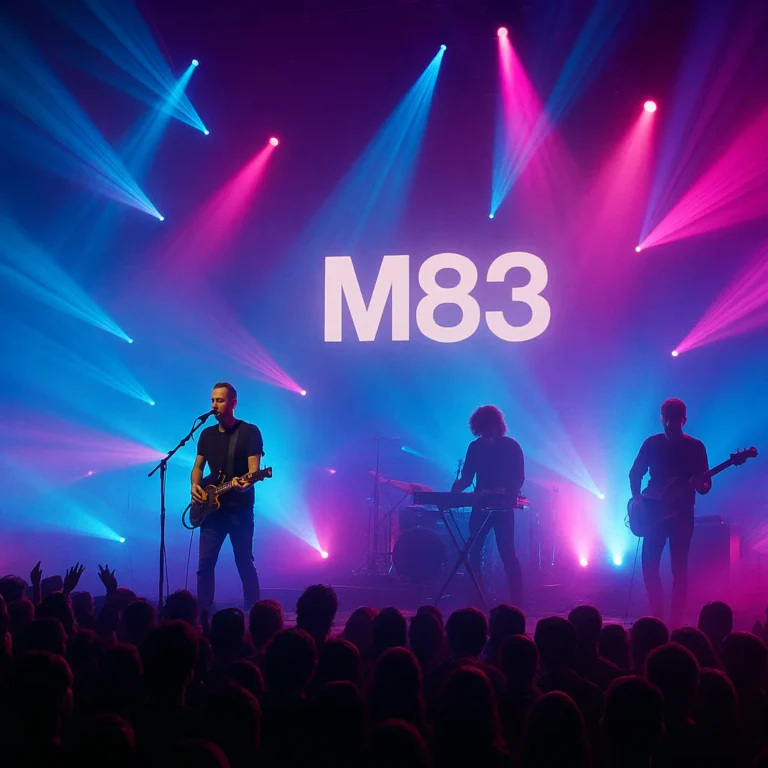
How the M83 Live Show Expands the Studio Recordings
A studio M83 track may contain dozens of layers. A live band must decide which layers are essential:
- The lead vocal remains emotionally legible.
- Synth parts are assigned to multiple keyboards.
- Guitar textures are translated into playable effects.
- Drum-machine patterns are reinforced by live percussion.
- Visuals and lighting extend the song’s cinematic character.
- Climaxes become physical rather than merely produced.
That is why M83 concerts can feel less like a reproduction of an album and more like a large-format reinterpretation.
🏆 M83’s Critical Reception, Awards, and Recognition
M83’s critical reputation has shifted with each stylistic turn. Hurry Up, We’re Dreaming received major acclaim and a Grammy nomination for Best Alternative Music Album, while Junk produced more divided responses.
Hurry Up, We’re Dreaming and “Midnight City” Aclaim
The 22-track double album established M83 as a major force in alternative electronic music. Its strengths include:
- Ambitious scale
- Memorable singles
- Strong sequencing
- A clear emotional theme
- Effective contrast between instrumental and vocal tracks
- A production style that works on headphones, in cars, and in large venues
“Midnight City” became the most recognizable single, but “Wait,” “Outro,” and “Steve McQueen” helped show the project’s range.
Oblivion Soundtrack Recognition
The Oblivion soundtrack earned attention for combining electronic production with orchestral science-fiction scoring. It also received recognition in awards-season contexts, including a World Soundtrack Awards nomination associated with the title song.
Award databases can be messy, especially when a score appears on longlists, eligibility lists, or nominations rather than final categories. For verification, trust the Academy of Motion Picture Arts and Sciences and World Soundtrack Academy over copied award claims on fan pages.
Anthony Gonzalez’s Influence on Modern Electronic Music
Gonzalez’s influence is not limited to artists who sound exactly like M83. His broader impact can be heard in the popularity of:
- Cinematic synth-pop
- Nostalgic electronic indie
- Shoegaze-inspired synth production
- Emotional instrumental electronica
- Hybrid live/electronic arrangements
- Vocal processing used for atmosphere rather than correction
He helped prove that electronic music could be melodically direct, emotionally vulnerable, and enormous without becoming anonymous.
🗓️ Anthony Gonzalez and M83 Timeline
2001: M83 Forms in Antibes, France
Anthony Gonzalez and Nicolas Fromageau establish M83 after their earlier post-rock work. The self-titled debut is recorded with modest equipment and introduces the project’s hazy electronic-rock vocabulary.
2003: Dead Cities, Red Seas & Lost Ghosts Expands the Sound
The second album deepens M83’s atmosphere with darker electronics, more layered guitars, and longer-form compositions. Its touring cycle eventually leads to the end of the original duo.
2005: M83 Becomes Anthony Gonzalez’s Solo Project
With Fromageau gone, Gonzalez continues M83 and releases Before the Dawn Heals Us. The album confirms that M83 is no longer dependent on a fixed two-person lineup.
2008: Saturdays = Youth Embraces 1980s Nostalgia
The album places youth, romance, and vintage synth-pop colors at the front of the project. It becomes a key stepping stone toward M83’s later mainstream breakthrough.
201: “Midnight City” Brings Worldwide Attention
The lead single from Hurry Up, We’re Dreaming becomes M83’s defining hit. Its synth hook, vocal refrain, and saxophone finale turn the project into a global electronic-indie name.
2013: Gonzalez Scores Oblivion
Gonzalez works with Joseph Trapanese on the science-fiction soundtrack. Susanne Sundfør’s vocals on the title song add a powerful new dimension to the M83-associated sound.
2016–2023: Junk, DSVII, and Fantasy
Gonzalez experiments with retro pop on Junk, ambient electronics on DSVII, and heavier synth-rock on Fantasy. The shifts confirm that M83 remains a creative project rather than a fixed genre exercise.
2025 and Beyond: Other Suns and Selective New Work
Gonzalez’s Other Suns label and soundtrack projects reflect a more independent, curated phase. M83’s future remains open-ended, which is fitting for a project named after a galaxy.
❓ Is Anthony Gonzalez Still the Lead Vocalist of M83?
Yes. Anthony Gonzalez remains M83’s lead vocalist and defining creative force.
That answer does not mean he sings every song or performs every vocal line. M83’s catalog includes guest singers, featured vocalists, instrumental tracks, and live arrangements with rotating performers.
Does Anthony Gonzalez Sing on Every M83 Track?
No. Some tracks are instrumental, and others feature guest vocalists. Gonzalez’s own voice is often treated subtly, which can make listeners wonder who they are hearing.
The most reliable way to identify a vocalist is to check:
- Official album credits
- Label release pages
- Streaming-service songwriter and performer credits
- Publisher or performing-rights information
- Interviews with the artist or label
Is M83 a Band or a Solo Project?
It is both, depending on context.
- Historically: M83 began as a duo.
- In the studio: It has largely functioned as Gonzalez’s solo project.
- Onstage: It operates as a band or collective with supporting musicians.
- Artistically: Gonzalez has described it as more than a strictly isolated solo act.
Calling M83 only a band hides Gonzalez’s central role. Calling it only a solo project ignores the musicians who have shaped its recordings and live shows.
What Happened to Nicolas Fromageau?
Nicolas Fromageau left M83 after the touring period connected to Dead Cities, Red Seas & Lost Ghosts. Gonzalez then carried the project forward, beginning a more independent phase with Before the Dawn Heals Us.
The dates are sometimes presented differently because sources may distinguish between the album’s release, touring period, and formal lineup change. The trustworthy takeaway is consistent: Fromageau was an original co-founder, but Gonzalez became M83’s sole constant member.
🔍 Why Anthony Gonzalez Matters to M83’s Sound
The simplest answer to the article’s central question is a name. The more interesting answer is a working method.
The Difference Between Founder, Frontman, and Lead Vocalist
These titles overlap but are not identical:
| Title | Meaning in M83’s case |
|---|---|
| Founder | Gonzalez helped establish M83 with Fromageau |
| Lead vocalist | Gonzalez performs the project’s principal recurring vocal role |
| Frontman | He represents the project publicly and performs live |
| Primary songwriter | He writes much of the core material |
| Producer | He shapes arrangements, recordings, and final sound |
| Multi-instrumentalist | He performs across electronic and acoustic instruments |
Gonzalez occupies all of these roles, although guest musicians and collaborators remain important.
How Gonzalez Blends Human Emotion With Electronic Production
M83’s emotional power comes from contrast:
- Mechanical pulse against fragile vocals
- Huge arrangements against intimate lyrics
- Vintage synthesizers against modern mixing
- Distorted guitar against clean melodic hooks
- Cosmic imagery against recognizable teenage feelings
This balance is why M83 connects with both electronic listeners and rock audiences. The production may be synthetic, but the emotional questions are deeply human: Who was I? What did I lose? Can I return? Why does the night make everything feel possible?
The Lasting Legacy of M83’s French Electronic Pop
M83 helped popularize a form of electronic music that is:
- Melodic without being lightweight
- Nostalgic without being trapped in the past
- Cinematic without needing a film
- Experimental without abandoning hooks
- Emotional without apologizing for grandeur
The project’s influence can be heard across modern synth-pop, indie electronic music, film trailers, and atmospheric pop production. For a wider look at adjacent artists and sounds, browse 80s Synth Pop and Modern Synth Pop.
The unresolved question from the beginning now has a straightforward answer: Anthony Gonzalez is the lead vocalist and founder of M83, but his achievement is larger than a credit line. He turned a teenage fascination with synthesizers into a flexible musical world that can hold a whisper, a guitar storm, a saxophone solo, and an entire galaxy.